
When Compassion Steps Aside
How harm becomes tolerable without anyone choosing it

There is a moment that interests me more than hatred.
It is not the moment someone shouts, insults, or openly dehumanises another group. That moment is loud, visible, and, however disturbing, easy to locate.
The moment I keep returning to is quieter.
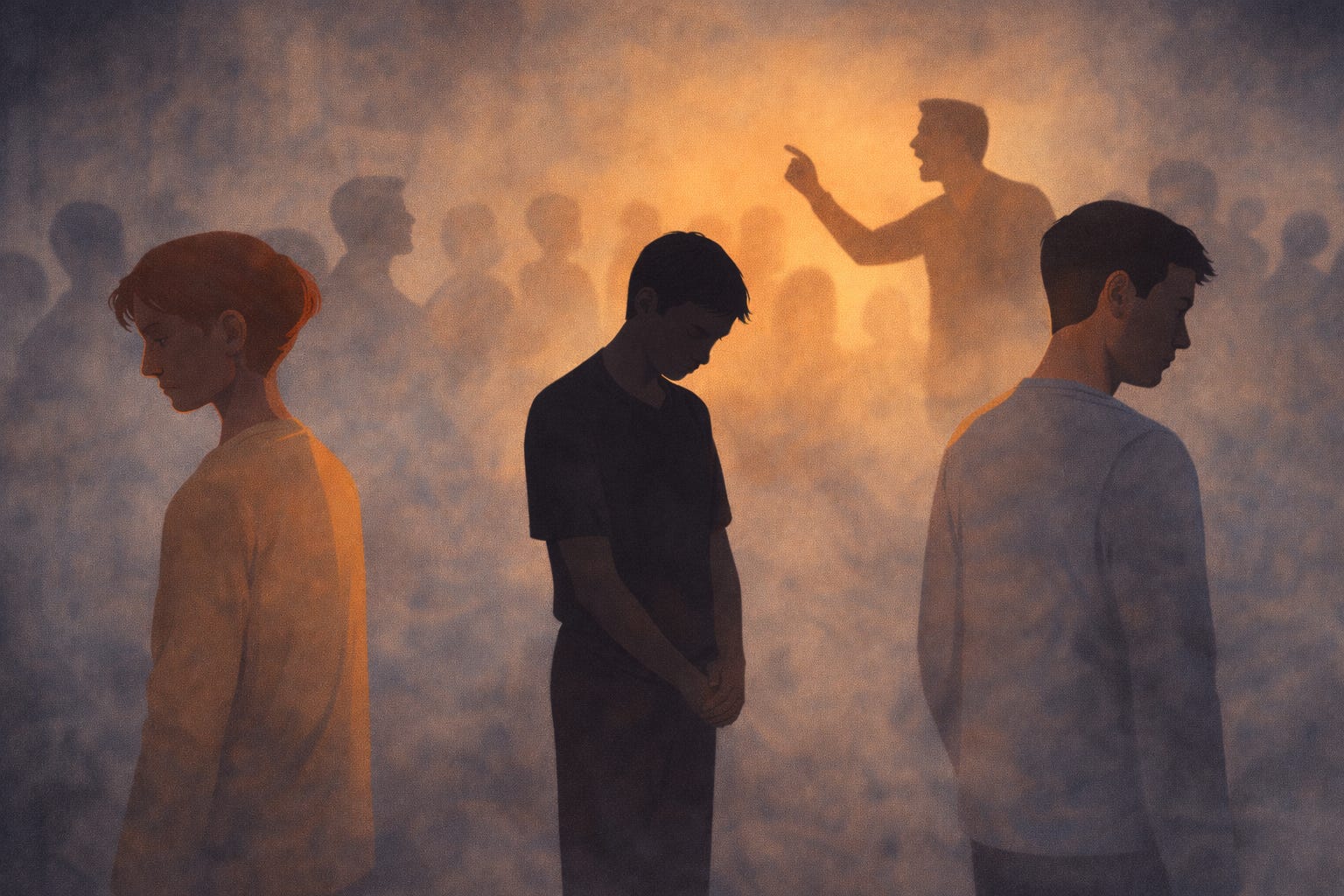
It is the moment when something morally troubling is noticed… and then set aside. When no one quite agrees with it, but no one quite intervenes either. When the emotional response is unease rather than outrage, and the practical response is distance rather than refusal.
This is not the absence of values.
It is values being gently outweighed.
Often the language sounds reasonable enough:
It’s complicated.
It’s not our role to decide.
We don’t endorse it, we merely allow it.
If we draw a line here, where does it end?
None of this requires cruelty. In fact, it often arises precisely because people want to avoid conflict, accusation, or moral grandstanding. Compassion doesn’t collapse; it simply steps aside.
I see this in small, everyday ways.
A workplace acknowledges that a colleague’s comments are “problematic,” but decides it would be disruptive to address them right now. A professional body notes rising harm within its field but postpones action until the evidence is “clearer.” A platform hosts material that unsettles many of its users but reassures itself that neutrality is safer than judgement.
In each case, no one is cheering the harm on.
They are simply choosing not to interrupt it.
And when that happens, something subtle but important changes.
Harm no longer needs to be justified, only tolerated.
Dehumanisation no longer needs enthusiasm, only permission.
History teaches us that violence begins long before actual attacks on others. It begins when people are spoken about rather than to. When groups are turned into abstractions. When moral discomfort is managed rather than listened to.
What interests me about our present moment is how often this process is mediated by systems rather than individuals. Platforms, institutions, policies, frameworks, all designed to be neutral, scalable, efficient.
Neutrality sounds safe.
But neutrality is not the same as innocence.
When a system treats all speech as equivalent, it quietly erases the difference between speech that argues and speech that erases. Between disagreement and dehumanisation. Between expression and incitement. The system may remain calm, but the moral ground beneath it has shifted.
No one feels responsible.
And yet responsibility has not disappeared.
This is how compassion fails now, not through rage, but through administrative distance. Not through hatred, but through a preference for procedural clarity over human consequence.
What follows is not usually dramatic. There is no single breaking point. Just a growing sense of unease among people who notice something is wrong but cannot quite name it or cannot quite act without feeling excessive.
That unease matters.
It is the last signal before numbness sets in.
I don’t think the task of our time is to shout louder or draw ever-harder moral lines. I think it is to learn to recognise the moment when compassion is being asked, politely, reasonably, to stand down.
And to pause there.
Because the most dangerous words are rarely hateful ones.
They are the words that make harm feel acceptable, inevitable, or someone else’s responsibility.
That is another example of when the compassion switch flips
.